









Can a Grandparent Secretly Baptize a Grandchild?
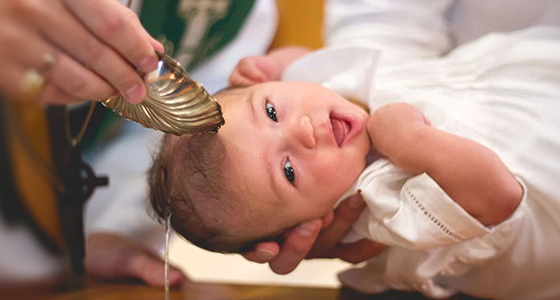
Grandparents often find themselves wondering if they are permitted to baptize their grandchild when his parent doesn’t want him baptized. And not just grandparents, but also caring individuals. I’ve had folks ask me this question countless times. It demands a thorough response.
Let’s start with what we shouldn’t do: baptize the child in secret. The Code of Canon Law (CIC) states that “for an infant to be baptized licitly . . . the parents or at least one of them or the person who legitimately takes their place must consent” (868 §1-1). And this would be true not just for infants, but also for any child under the age of reason, along with anyone who “habitually lacks the use of reason” (for example, someone with a mental illness or developmental disability) (97 §2; 99).
There are a few things to note here. First, consent by a parent or someone who takes his place is necessary for the baptism to be licit. But even an illicit baptism in this case would still be valid—that’s to say the child would be reborn and receive the graces of the sacrament, but it would be done in a way that contravenes Church law. In other words, if someone knows about this law, it would be immoral to contravene it, and he would sin in doing so.
The second thing to note is the canon’s point about someone “legitimately” taking the place of the parent. This is directed explicitly at the idea that someone might try to baptize a child in secret without the parents’ (or a parent’s) express permission.
Another condition for licit baptism is that there must be a reasonable hope that the child will be raised Catholic. Sections 1-2 of the canon 868 in the CIC state the following:
There must be a founded hope that the infant will be brought up in the Catholic religion; if such hope is altogether lacking, the baptism is to be delayed according to the prescripts of particular law after the parents have been advised about the reason.
The canon does, however, go on to specify that the above prescript is void in the danger of death:
An infant of Catholic parents or even of non-Catholic parents is baptized licitly in danger of death even against the will of the parents (§2).
Now, naturally, the question becomes, “Why?” Why does the Church forbid baptisms of children under the age of reason against the will of the parents? There are several reasons.
First, it is contrary to natural justice. Determination of what a child under the age of reason does and receives is naturally due to the parents. Thomas Aquinas teaches as much:
Those who do not yet have the use of free will (a child under the age of reason), according to the natural law they are under the care of their parents as long as they cannot look after themselves.
To baptize a child under the age of reason against the will of his parents, therefore, would be to deprive the parents of what is naturally due to them. And to deprive parents of what is naturally due to them is an injustice. Such an act would be just as much a violation of natural justice as it would be to attempt to baptize a person having the use of reason against his will. (As we’ll see below, this is impossible to do, but it’s still an injustice to try.)
Aquinas gives another reason behind the Church’s prohibition of baptizing children against the will of their parents: It makes the child liable to unbelief. He writes,
Moreover under the circumstances it would be dangerous to baptize the children of unbelievers; for they would be liable to lapse into unbelief, by reason of their natural affection for their parents. Therefore it is not the custom of the Church to baptize the children of unbelievers against their parents’ will.
One last reason that we’ll give here is that to baptize against the parents’ will is to thwart an aspect of the directionality, or goal-directedness, of the gift of faith. The Catechism teaches that baptism is a “sacrament of faith,” and the faith that is given in baptism is “called to develop” and “needs the community of believers” (CCC 1253).
To baptize a child knowing that the gift of faith imparted to him will not be nourished and developed by a community of believers would be to thwart the very natural directionality of the gift itself, kind of like when people thwart the directionality of the sexual act in the use of contraception, or the directionality of the act of eating by intentionally vomiting the food, or the directionality of the communicative act of assertion by lying.
Now, I sympathize with the person who says, “But this is urgent and serious. Wouldn’t you rescue a child from the danger of physical death? Why wouldn’t you do the same in the case of spiritual death?”
Aquinas also deals with this sort of objection and provides an insightful answer. He starts with a principle that I think most would agree upon—namely, we can’t go and rescue someone from physical death against the order of civil law. For example, if a judge condemns a man to death on account of a proportionate crime, we wouldn’t be morally permitted to use force to rescue the man from death. The reason is that such a judgment is issued by legitimate authority, and it’s immoral for us to act against such authority.
Similarly, as Aquinas teaches, we shouldn’t try to rescue a child from spiritual death against the will of the parents lest we infringe on the order of the natural law. The order of the natural law dictates that parents have the natural right to determine the actions of their children under the age of reason. And to baptize a child against his parent’s will would violate such an order.
But someone might still counter, “Don’t we belong more to God than to man? It’s God who gave us our soul, the primary principle within us. Only our bodies, which are lower in the hierarchy of being, have been given to us by our parents. Thus, it would seem it’s not unjust for a child to be baptized against his parents’ will.”
Again, here we appeal to the natural order articulated above: The actions of a child under the age of reason are subject to being determined by the parents. Here’s how Aquinas answers this sort of objection:
Man is ordained unto God through his reason, by which he can know God. Wherefore a child, before it has the use of reason, is ordained to God, by a natural order, through the reason of its parents, under whose care it naturally lies, and it is according to their ordering that things pertaining to God are to be done in respect of the child.
The bottom line is that although we belong to God more than to man, it’s God who willed the natural order. Therefore, to act against this natural order by baptizing a child under the age of reason against his parent’s will would be to act against God himself. And that’s something we ought always to avoid.
Now that we know what we shouldn’t do when our loved ones don’t plan on baptizing their children, let’s talk about what we can do or say.
One easy thing is to extend an invitation. Sometimes all it takes is a simple invitation for the parents to baptize their child. Given the distractions that our society has to offer young parents, and the lack of faith formation that is often present in people’s lives growing up, some parents simply may have never even considered baptism for their child. (Of course, it is important to be prudent here: If a baptism will awaken a long-dormant faith in the parents, it absolutely should be done, but this might not be the best course for faithless parents who might use it as an excuse for a party and then forget about it.)
You can also share with the parents the Church’s teaching on baptism and its spiritual effects. This would be not merely to convince them that it’s a good thing to baptize their child; also, we want to help lead the parents to conversion, creating within them a desire for regeneration and union with Christ.
Start by asking if they’d be interested in knowing why the Church thinks baptism is so important. If they express that they’re open to talking about it, then you can share with them the various spiritual gifts that baptism gives, the most important being salvation. And if you struggle to find the right words, then you can always just give them this book and pray that the Spirit will move their hearts.
For believers and nonbelievers alike, Baptism Now Saves You is the go-to source for understanding this ancient and essential practice
Recent Posts
-
Choirs of Angels in Scripture
The phrase choirs of angels does not mean a number of angels singing, as they did to announce to th …Mar 24th 2026 -
Explaining Apparitions and Visions of Angels
Church teaching, including Scripture and Tradition, holds that angels are purely spiritual beings. …Mar 15th 2026 -
Where Demons Dwell
And the great dragon was thrown down, that ancient serpent, who is called the Devil and Satan, the …Mar 5th 2026