









Making Every Day an Encounter with Jesus
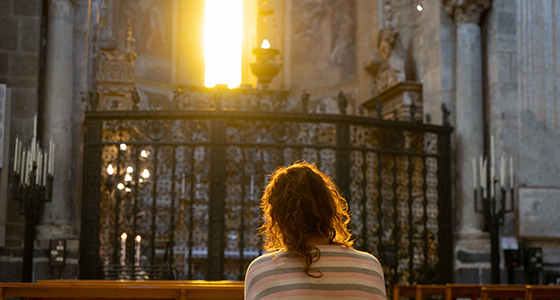
Lectio Divina
Lectio (Latin for “reading”) is an ancient way of letting God’s words speak to you as personally and as uniquely as possible. Normally, this practice takes a scene from the scriptures and allows them to serve as an opportunity to see our own life’s journey as an extension of God’s activity in history. Try it in these steps:
- Select a brief passage that draws you; perhaps this could be the Gospel reading for the Mass that day.
- Contemplate the passage slowly, hovering over any word or phrase or scene that strikes you. The key here is not to get through the passage but to let the Spirit talk to you at whatever point or for however much time you think is enough to savor all that he wants to show you here.
- Next, ask the Holy Spirit why this particular place in the biblical scene is resonating within you. What word, what image, what teaching is staying with you . . . and why? Is there anything in your memory that amplified this feeling or is there something coming up in your life that made this moment considerably significant at this time?
- If you are in the habit of (or would like to start) keeping a prayer journal (a sort of spiritual diary), this would be the time to jot down what has happened and what you and the Holy Spirit were just discussing.
In that spirit, let us here consider Luke’s account of Jesus and his disciples on the road to Emmaus (chapter 24). The scene begins, as does every authentic Christian moment, in a pilgrim encounter with the risen Lord. Dejected and defeated, two folks slink off away from Jerusalem. On their way, they unknowingly meet the Christ who has, unbeknownst to them, defeated all death. This initial encounter then begins to unfold through the typological fullness of the Old Testament being explained by this still unrecognized prophet: “Was it not necessary that the Messiah should suffer these things and enter into his glory? Then beginning with Moses and all the prophets, he interpreted to them what referred to him in all the scriptures” (Luke 24:26-27).
And then the scriptures gave way to the breaking of bread: “And it happened that, while he was with them at table, he took bread, said the blessing, broke it, and gave it to them. With that their eyes were opened and they recognized him, but he vanished from their sight” (Luke 24:30-31).
This movement, from the Liturgy of the Word to the Liturgy of the Eucharist, results in the third moment of this post-paschal scene. With the disciples’ sanctified souls now finally burning with zeal and understanding (Luke 24:32-33), they return to the life they had just recently fled from. Only now, after the word and sacrament have taken root in their hearts, are they equipped to go back into the world to spread and defend the new Christian faith.
This encounter with Jesus helps us understand too why so much of the spiritual life consists in prayerful reflection and remembrance.
We cannot know what will occur in the future, and most often we are too “close” to the present for us to understand it fully. Only by looking back on our day, examining our life through a regular retreat, by making a self-examination every evening, can we begin to understand how Christ is talking to us—how he wants to make our hearts burn with the knowledge and power of how God has fulfilled his promises to us and the world.
Allow these three moments to become matter for your prayer and growth in holiness.
The Word of God appears and entrusts himself to his followers, even entrusting his very self to the bread he holds—and becomes. This same historical encounter is continued and extended throughout all the world for all time, proclaimed in the scriptures and celebrated in the Eucharist. Thus, Jesus extends the same saving work of the road to Emmaus for you to partake of by which to be transformed into his likeness (cf. 2 Pet. 1:4).
Then let us arise! Scripture invites us in the words, “It is full time now for you to wake from sleep” (Rom. 13:11). With our eyes open to the light that transfigures, our ears filled with the thunder of his voice, let us listen to the powerful voice of God, urging us day by day, “Oh, that today you would hearken to his voice! Harden not your hearts” (Ps. 95:8). And again: “He who has an ear, let him hear what the Spirit says to the churches” (Rev. 2:7). And what does he say? “Come, O children, listen to me, I will teach you the fear of the Lord” (Ps. 34:11). “Walk while you have the light, lest the darkness overtake you” (John 12:35).
Moreover, the Lord, in seeking among the crowd for someone to work for him, says, “Who is there who desires life?” (Ps. 34:12). If you hear him and answer, “I do,” God says to you, ‘Do you desire true life, eternal life?” then: “Keep your tongue from evil, and your lips from speaking deceit. Depart from evil, and do good; seek peace, and pursue it” (Ps. 34:13-14). And when you have done this, I will set my eyes upon you, I will give ear to your prayers, and “Before they call, I will answer” (Isa. 65:24).
-St. Benedict of Nursia
Did you enjoy this excerpt from, The Soul of Apologetics? Order your copy today!
Recent Posts
-
Choirs of Angels in Scripture
The phrase choirs of angels does not mean a number of angels singing, as they did to announce to th …Mar 24th 2026 -
Explaining Apparitions and Visions of Angels
Church teaching, including Scripture and Tradition, holds that angels are purely spiritual beings. …Mar 15th 2026 -
Where Demons Dwell
And the great dragon was thrown down, that ancient serpent, who is called the Devil and Satan, the …Mar 5th 2026