









What is the Role of Guardian Angels?
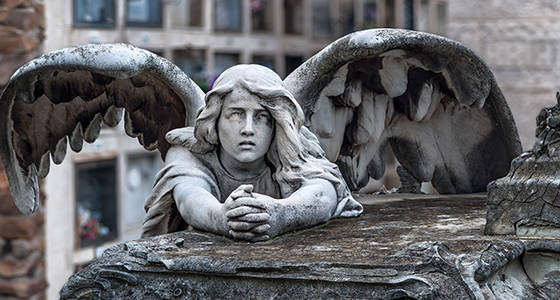
“Beside each believer stands an angel as protector and shepherd leading him to life.” This is how St. Basil, quoted in the Catechism (336), described the role of the guardian angels. Obviously, God does not need the assistance of the angels; he is capable of taking care of people without them. But in his wisdom God has seen fit to assign angels to watch over human beings. Perhaps because Lucifer, the leader of the fallen angels, led human beings to their downfall, it is appropriate that other angels take part in leading people to salvation. Another reason for this provident design of God is that human beings, in their weakness, can take comfort in knowing that they each have an angel specifically designated by him to watch over them.
There are differing opinions regarding when a person’s guardian angel is assigned to him. St. Anselm thought the assignment took place at the time of ensoulment, when one’s body and soul are created, more commonly referred to as conception. St. Jerome speculated that only Christians had guardian angels, receiving them when they were baptized. St. Thomas Aquinas, on the other hand, thought people received their guardian angel at birth; perhaps the mother’s angel, he reasoned, watched over the unborn child until he left the womb and his own guardian was given to him. Along with St. Jerome, he argued that all men, not only Christians, were assigned to the guardianship of an angel, as all need assistance in their journey through life.
There are many scriptural references to people being protected by angels. In the book of the prophet Daniel, the three Israelites who refuse to worship a golden idol are cast into a fiery furnace. They survive without even the smell of smoke touching their clothes, thanks to the protection of an angel. In the book of Tobit, Tobit is cured of blindness by the archangel Raphael, who also protects Tobit’s son Tobias from the demon Asmodeus. In the Acts of the Apostles, St. Peter is freed from his chains and from prison by an angel. When Jesus, in the Gospel of Luke, endured the agony in the garden of Gethsemane, “there appeared to him an angel from heaven, strengthening him” (22:43). As God the Son, he did not need an angel, but Jesus was also human; this event shows that angels give people strength in times of suffering.
In addition to guarding individuals, angels protect nations, cities, and even parishes. An angel helped lead the Israelites out of slavery in Egypt, and the book of the prophet Daniel names the archangel Michael as the guardian of the nation of Israel. During the time of the prophet Isaiah, an angel protected the city of Jerusalem from an imminent invasion by the Assyrians: “the angel of the Lord went forth, and slew a hundred and eighty-five thousand in the camp of the Assyrians; and when men arose early in the morning, behold, these were all dead bodies” (Isa. 37:36).
The book of Revelation mentions angels of churches in particular cities, but since these are sometimes reprimanded for their faults, the word “angel” in this context seems to refer to the bishop of the city. Nevertheless, there is a pious belief that every parish has its own guardian angel; for example, the archives of St. Columba Church in Ottawa, Illinois, reveal that the painting of an angel above the altar depicts the guardian angel of the parish.
In a Vatican document approved by Pope St. John Paul II (“Directory on Popular Piety and the Liturgy,” 2001), the practice of assigning names to angels was discouraged as a deviation from authentic spiritual piety.
Because angels were created at the beginning of the world, it is incongruous to think that after many eons of time, a human being can suddenly give a name to an angel.
Furthermore, assigning a name implies that the one giving it has authority over the one receiving it, as when parents name their children. Human beings are assisted and protected by angels, but that does not mean humans have authority over them.
Instead, just as people generally refer to their parents as “Mom” and “Dad,” the traditional practice is to refer to one’s angel simply as “Guardian Angel.”
Recent Posts
-
Choirs of Angels in Scripture
The phrase choirs of angels does not mean a number of angels singing, as they did to announce to th …Mar 24th 2026 -
Explaining Apparitions and Visions of Angels
Church teaching, including Scripture and Tradition, holds that angels are purely spiritual beings. …Mar 15th 2026 -
Where Demons Dwell
And the great dragon was thrown down, that ancient serpent, who is called the Devil and Satan, the …Mar 5th 2026