









Who Can Receive Baptism? Considering Special Cases
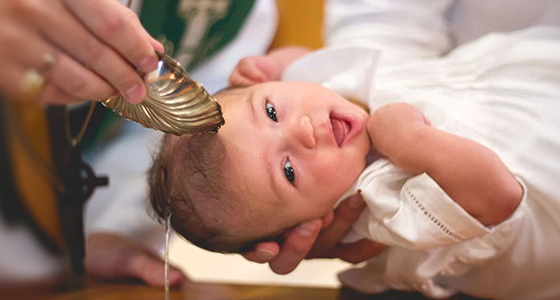
When it comes to the practice of baptism, questions arise as to who can receive it. At first glance, such questions might seem a bit pedantic, something only for theological nerds. But as we’ll see, these questions are at the heart of many of the conversations that we Catholics have about baptism, whether we’re talking to Catholics or Protestants. So let’s take a look at a few special cases that come up more frequently than others.
Can We Baptize Infants in the Womb?
What about an infant in the womb? Could we baptize an infant in the womb if he is in the danger of being miscarried? The short answer is “no,” since there is no practical way to apply the matter of water. Remember, the matter of water is one of the three conditions (the other two being form and intention) necessary for a valid baptism. The reason for this is that baptism is a physical act of washing that bestows supernatural grace. A person can’t baptize by mere intention alone. That means that the minister of baptism must be able to sprinkle or pour water on the baby, or immerse the baby in water, which cannot be done when the baby is surrounded in the womb with amniotic fluid.
Now, there’s also a theological rationale for why baptism can’t be administered to an infant in the womb. St. Thomas Aquinas argues along these lines, rooting the rationale in St. Augustine. Aquinas writes,
On the contrary, Augustine says (Ep. ad Dardan.): “No one can be born a second time unless he be born first.” But baptism is a spiritual regeneration. Therefore no one should be baptized before he is born from the womb.
The idea here is that since baptism is revealed by our Lord to be a second birth (John 3:3-5), albeit a spiritual birth, it shouldn’t be given until one has already been born a first time with his physical birth (whether naturally or through a C-section). To baptize prior to the first birth would be an act at odds with the nature of baptism itself.
Can We Baptize Adults Who Can't Use Reason?
Another category of people that is often asked about is adults who, for whatever reason, are severely mentally impaired such that they can’t use their rational faculties of intellect and will, whether such an adult was under this condition from birth or acquired it later.
Concerning those who would be in such a state from birth, the same line of reasoning that the Church employs for justifying the baptism of children under the age of reason would apply. So, these people could receive the sacrament.
But for those who once had intellectual lucidity and only became impaired later—say, through a brain injury—it would depend on what their wishes were when they had full use of their faculties. If, for example, a person had expressed a desire to be baptized before becoming rationally impaired, then baptism should be administered to him. If, on the other hand, prior to the mental impairment, a person never expressed a desire to be baptized, then baptism should not be administered.
What about if a person’s mental impairment isn’t permanent, and at times he has moments of lucidity? Well, if he were to express a desire to be baptized during such a time, then it would be appropriate to baptize him, even if he were to fall back into mental impairment. However, if a person were not to express any desire for the sacrament during this time of lucidity, then the sacrament ought not to be administered, just like how we wouldn’t attempt to baptize any adult without his express intention to be baptized.
Can We Baptize the Dead?
There’s one last group that we must ask about: the dead. This question about the dead arises due to a statement that Paul makes in 1 Corinthians 15:29: “What do people mean by being baptized on behalf of the dead? If the dead are not raised at all, why are people baptized on their behalf?”
It’s generally agreed that whatever baptism this was, it was not administered to the dead—that’s to say, baptizing the corpse. However, some, like the Mormons, have interpreted the passage in this way.
But even if Paul were describing Christians engaging in this ritual, there’s no indication that he approves it. In fact, the Synods of Hippo (393) and Carthage (397) condemned such baptisms.
Others have interpreted this “baptism” as a representative (“vicarious”) baptism, in which a person was baptized on behalf of someone who had died to obtain the baptismal graces for that deceased person, or as a baptismal ceremony that the person being baptized viewed as a way to intercede for his deceased loved ones.
Regardless, Paul’s point is that such baptism are futile without belief in a future resurrection.
For believers and nonbelievers alike, Baptism Now Saves You is the go-to source for understanding this ancient and essential practice—and for explaining it to friends and loved ones. At its foundation is the life-giving exhortation of St. Peter: “Repent, and be baptized every one of you.”
Order your copy today
Recent Posts
-
Why the Catholic Church is NOT a Denomination
In 1964, Pope Paul VI issued the Second Vatican Council’s “Decree on Ecumenism,” called Unitatis Re …Apr 8th 2026 -
St. Ignatius of Loyola and the Examination of Consciousness
St. Ignatius of Loyola (1491-1556) devised a way of examining our soul that moved away from looking …Apr 1st 2026 -
Choirs of Angels in Scripture
The phrase choirs of angels does not mean a number of angels singing, as they did to announce to th …Mar 24th 2026