









Baptism Now Saves You: Because Jesus Says So
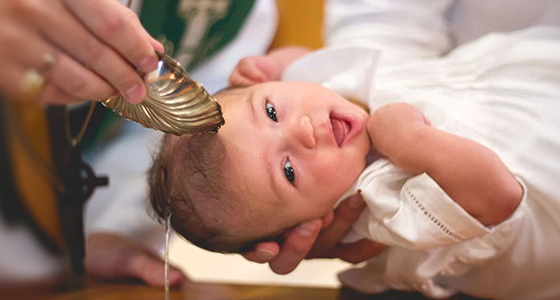
When it comes to biblical support for the belief in baptismal regeneration, there’s no better place to start than with Jesus himself. John 3:3-5, commonly known as the “Born Again” discourse, is the key passage for Jesus’ revelation of baptismal regeneration. Here’s the text:
“Truly, truly, I say to you, unless one is born anew, he cannot see the kingdom of God.” Nicodemus said to him, “How can a man be born when he is old? Can he enter a second time into his mother’s womb and be born?” Jesus answered, “Truly, truly, I say to you, unless one is born of water and the Spirit, he cannot enter the kingdom of God.”
The Council of Trent appealed to this passage in its teaching that natural water is necessary for baptism, stating in Canon 2 of its Canons on the Sacrament of Baptism, “If any one shall say, that true and natural water is not of necessity for baptism, and, on that account, wrests to some sort of metaphor those words of our Lord Jesus Christ, Except a man be born again of water and them Holy Ghost, let him be anathema.”
Jesus’ above statement comes within the context of a conversation that Jesus has with Nicodemus, “a teacher of Israel” (v.10). Jesus had told Nicodemus that to enter the kingdom of God, one must be “born anew” (v.3), which prompted a question: “How can a man be born when he is old? Can he enter a second time into his mother’s womb and be born?” (v.4). It’s in response to this question by Nicodemus that Jesus says, “Unless one is born of water and the Spirit, he cannot enter the kingdom of God” (v.5).
What do water and spirit refer to? We say baptism. But why?
There are two arguments we can give here to defend this claim. The first is derived from Jesus’ implication that what he’s talking about is rooted in the Jewish scriptures.
After revealing that a person must be born again to enter God’s kingdom, Jesus tells Nicodemus, “Do not marvel that I said to you, ‘You must be born anew’” (v.7). This prompts Nicodemus to ask again, “How can this be?” (v.9). Jesus answers, “Are you a teacher of Israel, and yet you do not understand this?” (v.10).
The implication here is that Jesus’ teaching about water, spirit, and new birth is rooted in Jewish tradition. And since Nicodemus is a teacher of that tradition, he should know about it.
But where in Jewish tradition? The answer is Ezekiel 36:25-27:
I will sprinkle clean water upon you, and you shall be clean from all your uncleannesses, and from all your idols I will cleanse you. A new heart I will give you, and a new spirit I will put within you; and I will take out of your flesh the heart of stone and give you a heart of flesh. And I will put my spirit within you, and cause you to walk in my statutes and be careful to observe my ordinances.
Notice how this passage contains the same themes present in Jesus’ conversation with Nicodemus: water, God’s spirit, and renewal. Given the combination of these themes, this is likely what Jesus expects Nicodemus to think of when he speaks of a new birth by water and Spirit. Jesus is teaching Nicodemus that the rebirth by water and Spirit is the event of cleansing and renewal that Ezekiel prophesied.
But what is this rebirth by water and Spirit, precisely? The answer is baptism. First-century Jews associated the hope of the age, when God would cleanse and renew his people by water and Spirit found in Ezekiel’s prophecy, with a baptismal ministry. The Jewish Encyclopedia says of this time:
To receive the spirit of God, or to be permitted to stand in the presence of God (his Shekinah), man must undergo baptism … in the messianic time God will himself pour water of purification upon Israel in accordance with Ezekiel 36:25.
The late New Testament scholar George Beasley-Murray explains,
The conjunction of water and Spirit in eschatological hope is deeply rooted in the Jewish consciousness, as is attested by Ezekiel 36:25-27 and various apocalyptic writings (e.g., Jub. 1:23; Pss. Sol. 18:6; Test Jud 24:3), but above all the literature and practices of the Qumran sectaries, who sought to unite cleansing and the hope of the Spirit with actual immersions and repentance in a community beginning to “see” the kingdom of God (cf. 1QS 3:6-9; 1QH 11:12-14).
If the Jews saw the event of Ezekiel’s prophecy as a baptism for the age of cleansing and renewal, and Jesus intends Nicodemus to understand rebirth by water and Spirit in terms of that event, then it follows that Jesus intends baptism to be the new birth by water and Spirit.
This interpretation that the new birth refers to baptism is further confirmed by the preceding and subsequent context of the passage in question, which makes for a second argument in favor of the sacramental interpretation of the text. The images of Spirit and water together constitute the one event of Jesus’ baptism, which John hints at in John 1:29-34. In John 3:23, he records how John the Baptist was baptizing at Aenon near Salim. We’re also told in John 4:1-2 that the apostles went about baptizing.
If the instruction to be born again of water and Spirit is surrounded both before and after by the theme of baptism, then it’s reasonable to conclude that baptism is what Jesus has in mind when he speaks of the necessity to be born of water and spirit for entrance into heaven. And if that’s the case, then Jesus reveals that baptism saves.
Did you enjoy this excerpt from Baptism Now Saves You? Order your copy today!
Recent Posts
-
Choirs of Angels in Scripture
The phrase choirs of angels does not mean a number of angels singing, as they did to announce to th …Mar 24th 2026 -
Explaining Apparitions and Visions of Angels
Church teaching, including Scripture and Tradition, holds that angels are purely spiritual beings. …Mar 15th 2026 -
Where Demons Dwell
And the great dragon was thrown down, that ancient serpent, who is called the Devil and Satan, the …Mar 5th 2026