









Choirs of Angels in Scripture
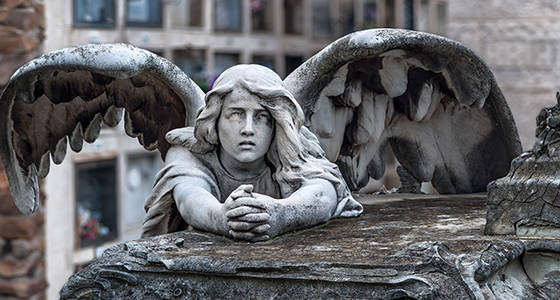
The phrase choirs of angels does not mean a number of angels singing, as they did to announce to the shepherds that the Savior had been born. Rather, we will be looking at different groups of angels and the hierarchy among them. The Church has nothing doctrinal, no official teaching, on the specifics of these groups of angels, other than that they exist, as named in the Bible and in Tradition. The Bible gives us the following names of the nine choirs: Seraphim, Cherubim, Thrones, Dominions, Virtues, Powers, Principalities, Archangels, and Angels.
Seraphim, which means Burning Ones, are named just once in the Bible, by the prophet Isaiah, who describes a vision God had given to him.
I saw the Lord sitting upon a throne, high and lifted up; and his train filled the temple. Above him stood the seraphim; each had six wings: with two he covered his face, and with two he covered his feet, and with two he flew. And one called to another and said: “Holy, holy, holy is the Lord of hosts; the whole earth is full of his glory.”
Then flew one of the seraphim to me, having in his hand a burning coal which he had taken with tongs from the altar. And he touched my mouth, and said: “Behold, this has touched your lips; your guilt is taken away, and your sin forgiven” (Isa. 6:1-3, 6-7).
The book of Revelation does not name the seraphim, but St. John appears to be describing them, given the similarity to Isaiah.
And the four living creatures, each of them with six wings, are full of eyes all round and within, and day and night they never cease to sing, “Holy, holy, holy, is the Lord God Almighty, who was and is and is to come!” (Rev. 4:8).
Cherubim, sometimes translated Mighty Ones, are mentioned more often. In the book of Genesis, there is the mysterious verse telling us that man can never return to the garden of Eden because it is guarded by the cherubim.
He drove out the man; and at the east of the garden of Eden he placed the cherubim, and a flaming sword which turned every way, to guard the way to the tree of life (Gen. 3:24).
The book of Exodus tells us that God directed the Israelites to have images of cherubim both on the cover of the Ark of the Covenant and woven into the fabric of the curtains in which the Ark is kept (26:1). The book of Numbers states that on at least one occasion, Moses heard the voice of God coming from between the cherubim over the Ark (7:89). In the first book of Kings, when Solomon had a temple built to house the Ark, he included images of cherubim (6:23-28). We do not learn what the images looked like, other than having two large wings. For the Israelites, the Ark was the most powerful presence of God; the gold-carved cherubim represent heaven, where God is among the actual cherubim. The book of Psalms repeatedly mentions the image of God enthroned upon the cherubim, as does the prophet Ezekiel. This idea is also part of a prayer of King Hezekiah.
O Lord the God of Israel, who art enthroned above the cherubim, thou art the God, thou alone, of all the kingdoms of the earth; thou hast made heaven and earth (2 Kings 19:15).
The next choirs of angels are barely mentioned in Scripture. Though he says nothing about the hierarchy or role of any of these choirs, St. Paul mentions them in two places. In his letter to the Ephesians, Paul says that Christ has been raised to the right hand of God, “above all principality, and power, and virtue, and dominion” (1:21, Douay-Rheims). He also names several choirs in his letter to the Colossians: “For in him were created all things in heaven and on earth, the visible and the invisible, whether thrones or dominions or principalities or powers” (1:16, NABRE).
Archangels are mentioned by name twice in the Bible. In his first letter to the Thessalonians, Paul says that a particular unnamed archangel will call out with Jesus when he comes at the end of the world:
For the Lord himself will descend from heaven with a cry of command, with the archangel’s call, and with the sound of the trumpet of God (4:16).
An archangel also appears in an inexplicable verse from the book of Jude: “The archangel Michael, contending with the devil, disputed about the body of Moses” (Jude 1:9).
Tradition places both Gabriel and Raphael also within the choir of Archangels, of whom seven seem to have a special role in “standing before God” on behalf of men:
And the angel answered him, “I am Gabriel, who stand in the presence of God; and I was sent to speak to you, and to bring you this good news” (Luke 1:19).
I am Raph′ael, one of the seven holy angels who present the prayers of the saints and enter into the presence of the glory of the Holy One (Tob. 12:15).
Then I saw the seven angels who stand before God, and seven trumpets were given to them (Rev. 8:2).
This leaves one more, the last of the choirs: the choir of Angels. The word angel is used hundreds of times throughout the Bible, and it can refer either to those in this particular choir or to all of the angels in general.
There is so much to know about angels. Get your copy of Angelic Answers today!
Recent Posts
-
Choirs of Angels in Scripture
The phrase choirs of angels does not mean a number of angels singing, as they did to announce to th …Mar 24th 2026 -
Explaining Apparitions and Visions of Angels
Church teaching, including Scripture and Tradition, holds that angels are purely spiritual beings. …Mar 15th 2026 -
Where Demons Dwell
And the great dragon was thrown down, that ancient serpent, who is called the Devil and Satan, the …Mar 5th 2026