









The Inseparable Connection Between the Stigmata and the Eucharist
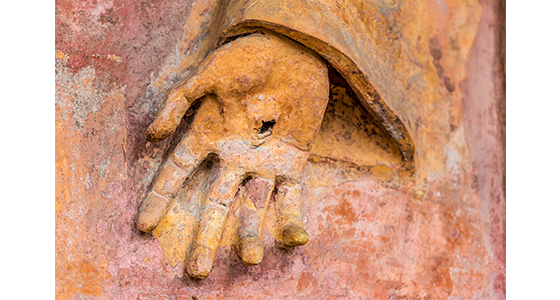
Let the entire man be seized with fear;
let the whole world tremble;
let heaven exult when Christ,
the Son of the Living God,
is on the altar in the hands of the priest.
—St. Francis of Assisi
A study of the lives of the blessed and canonized stigmatists illustrates some significant differences among them, but it also reveals some remarkable similarities; one of those similarities is an overwhelming devotion to the Eucharist. While this might not be surprising, what is more so is the frequency with which stigmatists were favored with eucharistic miracles. Of course, eucharistic miracles have also been associated with non-stigmatist saints, but the percentage of these latter who experienced a eucharistic miracle is only a tiny fraction, whereas the percentage seems to hover around 100 percent in cases of saintly stigmatists. Why is it that miracles of the stigmata so often coincide with eucharistic miracles? As we will see, we are not talking about a few isolated eucharistic miracles; rather, many stigmatists exhibited ongoing miracles with Jesus in the Eucharist. Indeed, a comprehensive and detailed account of the eucharistic miracles experienced by the stigmatists could fill volumes.
Eucharist & Mass, Sacrifice & Stigmata
To begin our discussion, we must take a closer look at the Eucharist. In his book The Hidden Manna: A Theology of the Eucharist, Fr. James O’Connor explains that “in the Eucharist, Christ is truly contained . . . the same body born of Mary, dead on the cross, raised gloriously from the tomb. It is not a different body from the one that ‘sits at the right hand of the Father,’ nor is it a part of that body, nor some kind of amorphous extension of that body. The Eucharist is the identically one, risen body of the Lord, only the mode or manner of presence differing from that which it exhibits in heaven.” The knowledge of this teaching is essential to make sense of the relationship between the stigmata and the Eucharist.
In short, by means of the Eucharist, Christ desires to include the entire Church in his sacrifice. Pope John Paul II explains this concept beautifully:
The sacrifice of the cross is so decisive for the future of man that Christ did not carry it out and did not return to the Father until he had left us the means to take part in it as if we had been present. Christ’s offering on the cross—which is the real Bread of Life broken—is the first value that must be communicated and shared. The Mass and the cross are but one and the same sacrifice. Nevertheless the eucharistic breaking of bread has an essential function, that of putting at our disposal the original offering of the cross. It makes it actual today for our generation. By making the Body and Blood of Christ really present under the species of bread and wine, it makes—simultaneously—the sacrifice of the cross accessible to our generation, this sacrifice which remains, in its uniqueness, the turning point of the history of salvation, the essential link between time and eternity. [emphasis added]
Today’s Catholic faithful were not physically present at the foot of the cross, yet, mystically, we can still partake in that sacrifice as though we were. As John Paul II explains in his encyclical letter Ecclesia de Eucharistia: “By offering them his body and his blood as food, Christ mysteriously involved them in the sacrifice which would be completed later on Calvary” . Not only does the Eucharist allow the fruits of Christ’s self-offering to be intimately communicated to each one of us, but “in giving his sacrifice to the Church, Christ has also made his own the spiritual sacrifice of the Church, which is called to offer herself in union with the sacrifice of Christ” .
Although Christ’s sacrifice “was sufficient for the reconciliation of the entire world,” explains O’Connor, nonetheless, “he willed and wills to associate us with that sacrifice.” We all share in Christ’s royal priesthood at the cross and can make of our own lives and sufferings an offering with him to the Father in co-redemptive suffering. Far from being a morbid preoccupation with suffering, the Eucharist takes hold of a natural part of all human existence—suffering—and transforms it from consequence of sin to instrument of salvation. As O’Connor writes, Christ “willed to dignify and ennoble us, inserting into our own race the ability to satisfy for our evils.”
Although all the Catholic faithful participate to some degree in the satisfaction for sin obtained by Christ’s redemptive self-offering, some men and women are able to participate in that satisfaction magnificently. And here, in this participation, we can begin to understand the stigmata. The stigmatist not only participates in this sacrifice, but provides a living reminder of Jesus’ sacrifice on the cross. As we can see, there is an inescapable bond between the passion and death of Jesus, the Mass wherein this sacrifice is made present, and the Eucharist. Thus, it is fitting that those men and women who bear the wounds of Jesus’ sacrifice also experience eucharistic miracles at a much greater frequency.
Did you enjoy this excerpt from John Clark's new book, God's Wounds? Order your copy today!
Recent Posts
-
St. Ignatius of Loyola and the Examination of Consciousness
St. Ignatius of Loyola (1491-1556) devised a way of examining our soul that moved away from looking …Apr 1st 2026 -
Choirs of Angels in Scripture
The phrase choirs of angels does not mean a number of angels singing, as they did to announce to th …Mar 24th 2026 -
Explaining Apparitions and Visions of Angels
Church teaching, including Scripture and Tradition, holds that angels are purely spiritual beings. …Mar 15th 2026