









The Assumption of Mary: What Catholics Believe
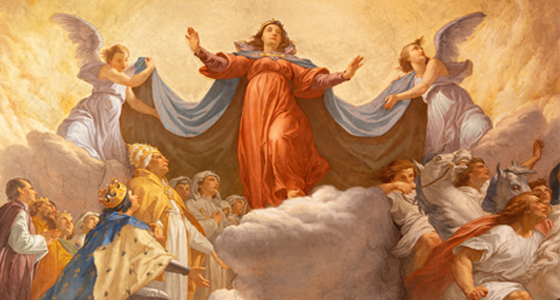
Finding the gospel of Jesus Christ reflected in Mary may help us pursue the unity of spirit and mind that Paul sought:
Let your manner of life be worthy of the gospel of Christ, so that . . . I may hear of you that you stand firm in one spirit, with one mind striving side by side for the faith of the gospel, and not frightened in anything by your opponents (Phil. 1:27-28).
Side by side, of one mind and spirit, let us fight for the Faith against all opposition, testing the spirit of Marian doctrines and beliefs, to discern their worthiness in Christ’s gospel:
Beloved, do not believe every spirit, but test the spirits to see whether they are of God; for many false prophets have gone out into the world. By this you know the Spirit of God: every spirit which confesses that Jesus Christ has come in the flesh is of God. . . . Whoever confesses that Jesus is the Son of God, God abides in him, and he in God (1 John 4:1-3,15).
Some are surprised that the doctrine of Mary’s bodily assumption was not defined until 1950, using little biblical support. The pope decreed that all Catholics must hold and believe as divinely revealed “that the immaculate Mother of God, the Ever-Virgin Mary, having completed the course of her earthly life, was assumed body and soul into heavenly glory” (Munificentissimus Deus 44).
Yet this doctrine was no twentieth-century innovation, as Tim Perry explains:
When seeking to understand the bodily assumption of Mary into heaven with any degree of sympathy (this is not to say agreement), two factors need to be kept constantly in mind. The first is the doctrine’s ancient roots.
The ancient Church found that it fit Scripture and that it was consistent with other Christian beliefs. By the fourth century, Christians celebrated the feast of Mary’s dormition, especially in Jerusalem. The dormition refers to Mary “falling asleep” before being assumed (taken up bodily) into heaven to be with our Lord. Finding no evidence of Mary’s death, Epiphanius (d. 403) suggests that this Marian teaching was true, as “nothing is impossible for God.” Several Church Fathers preached about it, such as Germain (d. 733), Andrew of Crete (d. 740), and John Damascene (d. 749). Gregory (d. 594), bishop of Tours, recorded part of a Latin translation of a lost fifth-century Greek book describing Mary’s assumption. John of Thessalonica (d. 630) detailed the popular belief regarding Mary’s dormition and assumption. Although some details may have been embellished over time, his exposition shows that some truth likely lies behind this commonly held belief.
So why would the Holy Spirit wait for the twentieth century to define this teaching? Perhaps it was to counteract the materialistic and mechanistic view of man propagated by some in the name of science. Mary’s assumption reaffirms the Christian hope in bodily resurrection—which science finds absurd—attesting to man having a spiritual dimension that endures unto eternity. Whereas sin naturally produces death and corruption, the teaching of Mary’s assumption reinforces the Christian belief in Christ’s resurrection (1 Cor. 15:12-19) and in the bodily resurrection of all Christians (CCC 974).
To understand the Assumption is to understand Christian belief about death and bodily resurrection. Paul wrote consolingly on death and our hope in bodily resurrection:
But we would not have you ignorant, brethren, concerning those who are asleep [dormition], that you may not grieve as others do who have no hope. For since we believe that Jesus died and rose again, even so, through Jesus, God will bring with him those who have fallen asleep. . . .For the Lord himself will descend from heaven with a cry of command, with the archangel’s call, and with the sound of the trumpet of God. And the dead in Christ will rise first; then we who are alive, who are left, shall be caught up [raptured] together with them in the clouds to meet the Lord in the air; and so we shall always be with the Lord (1 Thess. 4:13-18).
This description of rapture is familiar to most Christians, with many interpretations. One popular belief is that Christians living at Christ’s Second Coming will be taken or caught up, body and soul, into heaven without dying. So many Bible-believing Christians see Mary’s assumption—rapture—into heaven as quite compatible with Scripture.
Another passage from Paul suggests rapture:
Lo! I tell you a mystery. We shall not all sleep [dormition], but we shall all be changed, in a moment. . . . For the trumpet will sound, and the dead will be raised imperishable, and we shall be changed. For this perishable nature must put on the imperishable, and this mortal nature must put on immortality . . . then shall come to pass the saying that is written:“Death is swallowed up in victory.”“O death, where is thy victory? O death, where is thy sting?”The sting of death is sin, and the power of sin is the law (1 Cor. 15:51-56).
Not all shall die (sleep), but some shall put on immortality without dying, affirming Christ’s victory over sin and death (1 Thess. 4:18). As death is the result of sin, death has no power or sting over a person freed from sin.
Want to learn more about what Scripture reveals about Mary? Bible Mary by Fr. John Waiss explores the biblical foundations of Catholic teaching about the Blessed Virgin Mary.
Recent Posts
-
The Assumption of Mary: What Catholics Believe
Finding the gospel of Jesus Christ reflected in Mary may help us pursue the unity of spirit and min …Sep 8th 2026 -
Understanding Natural Law from a Catholic Perspective
My teens always looked forward to the homilies of a particular priest, because he made the truths o …Aug 25th 2026 -
The Reason For Hell
“What you people do is child abuse! You should be ashamed of yourselves!” a woman screamed at me wh …Aug 20th 2026