









Are All Christians Equal?
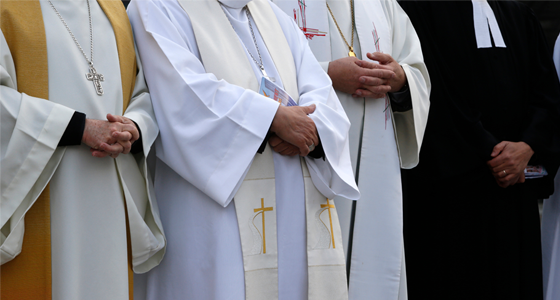
THE PROTESTANT CHALLENGE: How can the Catholic Church teach that some Christians have more authority than others when Scripture says that we’re all one in Christ?
The Catechism teaches that in the Church there are “hierarchy and laity” (873), and that the Lord wills such differences between the members of his body. Paragraphs 874 and 877 speak of the Church as having a “variety of offices” and being constituted with a “sacred hierarchy.”
But for some Protestants,xx this teaching on hierarchy contradicts what Paul writes in Galatians 3:28: “There is neither Jew nor Greek, there is neither slave nor free, there is neither male nor female; for you are all one in Christ Jesus.” To Paul, we’re all equal, which disproves the Catholic belief that the Church is constituted with a hierarchy.
MEETING THE CHALLENGE
- Paulcan’t be denying the hierarchical nature of the Church, because there is evidence that both Jesus and Paul understood the Church to be hierarchical.
We can start with Jesus. That Jesus selects twelve men to be his “apostles” apart from all other believers reveals his intention to establish his Church with a hierarchy (Matt. 10:1-4). In Luke 22:29-30, we discover that he makes these apostles rulers in his kingdom. Jesus promises to assign his kingdom to the apostles (as the Father assigned it to him) and give them the authority to “sit on thrones judging the twelve tribes of Israel” (v.30).
A possible background for the imagery of sitting on thrones to judge is Psalm 122:5, which speaks of the “thrones for judgment…of the house of David.” Such thrones were seats for the royal ministers of the Davidic kingdom that governed Israel. With this background in mind, it’s possible that when Jesus speaks of his apostles sitting on thrones to judge in his kingdom he intends his apostles to be for the new Davidic kingdom, the Church, what the royal ministers were for the old Davidic kingdom: rulers who govern. And if they are rulers who govern, they constitute a hierarchy in Jesus’ Church.
Jesus’ intention for his Church to be hierarchical is further supported by his appointment of Peter as head of the twelve. Consider what Jesus tells Peter in Matthew 16:18-19:
And I tell you, you are Peter, and on this rock I will build my church, and the powers of death shall not prevail against it. I will give you the keys of the kingdom of heaven, and whatever you bind on earth shall be bound in heaven, and whatever you loose on earth shall be loosed in heaven.
There are three clues that suggest Peter’s superior rank of authority. First, Peter is the foundational “rock” of the Church. As we noted previously, the name Peter (Greek, petros) means “rock,” as John the evangelist confirms in John 1:42. If Peter is the visible foundation of Jesus’ Church on earth, that makes him the visible source of unity. Wherever the foundation is, there is the true Church of Jesus.
Second, Peter is given the “keys of the kingdom.” In the Jewish tradition, this imagery signifies an institutional office in the Davidic kingdom known as the royal steward or master of the palace. This official had royal authority second to no one except the king himself (Isa. 22:15-22). Therefore, Jesus’ handing over the keys to Peter signifies Peter as the royal steward, second in authority only to King Jesus.
The third clue is Jesus’ exclusive instruction for Peter to “bind and loose.” We know from Matthew 18:18 that the Church as a whole has authority to bind and loose as well. But notice here that Jesus singles out Peter. This suggests that Peter has a unique authority to bind and loose, an authority that he can exercise on his own, which ranks him above the collegial authority of the Church.
This higher rank that Peter has among the twelve explains why Matthew lists Peter as “first” in Matthew 10:2. The Greek word used here, protos, can be used either to connote a chronological order or to suggest a primacy of place, like “first and foremost,” or “most prominent.”xxi
It doesn’t seem that Matthew is using protos in a chronological sense. He can’t be using it to refer to the chronological order of the apostles’ calling because Andrew was called first, not Peter (John 1:42). Nor can he be using it to refer to an order in a list, since he doesn’t speak of a “second,” “third,” etc. Therefore, Matthew must intend protos to refer to Peter having a primacy of place among the twelve, the “first and foremost,” or “most prominent” apostle. That’s hierarchy!
Now we can turn to Paul himself for evidence of the hierarchical nature of the Church. In Acts 14:23 we read that Paul appointed “elders” (Greek, presbuteroi; “presbyters” or “priests”) in every church throughout their apostolic journeys. In Acts 20, he convenes the presbyters of the church in Ephesus and confirms them in their leadership role: “Take heed to yourselves and to all the flock, in which the Holy Spirit has made you guardians, to feed the church of the Lord” (v.28).
The office of the bishop is another hierarchical office that Paul gives instructions about—for example, in 1 Timothy 3:1-3, calling the office of the bishop a “noble task.” The Greek word that Paul uses for “office of bishop” is episkopē, which is the same word used to describe the apostolic office in Acts 1:20. This suggests that the bishops (episkopoi; “overseers”) of the early Church, like the apostles, were to exercise oversight in the Church, which proves its hierarchical nature.
The other role that constituted part of the hierarchy in the early Church was that of the deacon. In 1 Timothy 3:8-13, Paul gives Timothy instructions about this office as well, immediately after he gives instructions concerning the office of the bishop.
For Paul, the ministers that occupy these various offices were to be given special honor. He writes to Timothy concerning the presbyters: “Let the elders who rule well be considered worthy of double honor, especially those who labor in preaching and teaching” (1 Tim. 5:17). Paul gives the same instruction to the Christians in Thessalonica, telling them to “esteem them [those who labor over us in the Lord] very highly in love” (1 Thess. 5:13).
We can also include the book of Hebrews, although we don’t know if Paul wrote it. For example, it says in 13:17, “Obey your leaders and submit to them; for they are keeping watch over your souls.” Just a few verses earlier, in verse 7, the author writes, “Remember your leaders, those who spoke to you the word of God; consider the outcome of their life, and imitate their faith.”
That bishops, presbyters, and deacons exercised oversight and governing authority in the early Church, and that such ministers were to be given honor and obedience, allows us to conclude that not every member of the Christian community had equal roles, but rather that there was a hierarchy of authority.
- Membership in the hierarchy for the earlyChurch was objectively verifiable through the rite of ordination by the laying on of hands and their commission to appoint others to the hierarchy and teach with authority.xxii
Just as Moses laid hands on Joshua as a visible sign of the conferring of authority (Num. 27:22-23; cf. Deut. 34:9), so to the apostles laid hands on men as a sign of conferring apostolic authority.
For example, Paul speaks of how he laid hands on Timothy: “Hence I remind you to rekindle the gift of God that is within you through the laying on of my hands” (2 Timothy 1:6). This suggests an ordination to a specific ministerial office in the hierarchy.
Timothy’s position in the hierarchy is further supported by the fact that Paul tasks him with appointing other men to hierarchical roles in the Church: “Do not be hasty in the laying on of hands” (1 Tim. 5:22).
This follows upon Paul’s instructions to Timothy about how we should consider “elders” as “worthy of double honor” (1 Tim. 5:17), and how Timothy is to discern which men are worthy to be “bishops” (1 Tim. 3:1-7) and “deacons” (1 Tim. 8-13). That Timothy is to oversee these ministries suggests that he belongs to the hierarchy of the early Church.
Timothy is also given the authoritative task to “command and teach” (1 Tim. 4:11), along with rebuking those who come along and teach things contrary to sound teaching (2 Tim. 4:1-5).
Titus is given similar instructions to Timothy’s. For example, in Titus 1:5, Paul instructs him to “appoint elders in every town.” A few verses later, Paul gives Titus authority to “rebuke sharply” (v.13) and “silence” (v.11) those “insubordinate men, empty talkers and deceivers” of the “circumcision party” (v.10). That Titus has authority to appoint elders and authoritatively rebuke those who teach contrary to sound doctrine reveals that he too belongs to the hierarchy in the early Church.
- Equality in dignity and diversity in roles among members of the Body of Christarenot mutually exclusive.
Paul indeed teaches that we are all one in Christ, yet this doesn’t mean that everyone has the same role to play. There is a difference between equality in dignity and equality in roles. The Bible affirms the former, but denies the latter.
The above passages prove as much. But there are more. Consider, for example, Paul’s list of ministries in the Church:
And God has appointed in the church first apostles, second prophets, third teachers, then workers of miracles, then healers, helpers, administrators, speakers in various kinds of tongues. Are all apostles? Are all prophets? Are all teachers? Do all work miracles? Do all possess gifts of healing? Do all speak with tongues? Do all interpret? But earnestly desire the higher gifts (1 Cor. 12:28-31).
Notice that Paul lists the ministries in a ranking order, thus revealing that he believes the Church is hierarchical.
Similarly, Paul writes in Ephesians 4:11, “And his gifts were that some should be apostles, some prophets, some evangelists, some pastors and teachers.” For Paul, the very purpose of these distinct ministries is to
equip the saints for the work of ministry, for building up the body of Christ, until we all attain to the unity of the faith and of the knowledge of the Son of God, to mature manhood, to the measure of the stature of the fullness of Christ (Eph. 4:12-13).
These passages show that not everybody in the Church has the same function, and that the different functions in the Church are ranked according to their importance. Thus, Scripture teaches that the early Church was hierarchical.
COUNTER-CHALLENGE: Why must unity and diversity of roles in the Church be mutually exclusive? Can’t they exist together?
AFTERTHOUGHT: The threefold hierarchical nature of the Church—bishops, priests, and deacons—is confirmed in early post-apostolic writings as early as A.D. 107 or 110. The early Church Father Ignatius of Antioch writes, “In like manner, let all reverence the deacons as an appointment of Jesus Christ, and the bishop as Jesus Christ, who is the Son of the Father, and the presbyters as the Sanhedrin of God, and assembly of the apostles. Apart from these, there is no Church.”xxiii
Strengthen your ability to defend the Catholic faith with Meeting the Protestant Challenge by Karlo Broussard. Discover biblical answers to common Protestant objections and order your copy today!
Recent Posts
-
Mother Teresa: All for Jesus
As we should expect, Mother Teresa’s idea of holiness was simple and direct. For her, sanctity begi …Sep 30th 2026 -
The Key to Happiness
Let’s lay down some groundwork by considering why we act as we do. Unlike irrational animals driven …Sep 24th 2026 -
Debunking Catholic Socialism
Poverty and unjust working conditions are real problems, and sometimes their root lies in an unjust …Sep 22nd 2026