









Why Do We Have Sacraments?
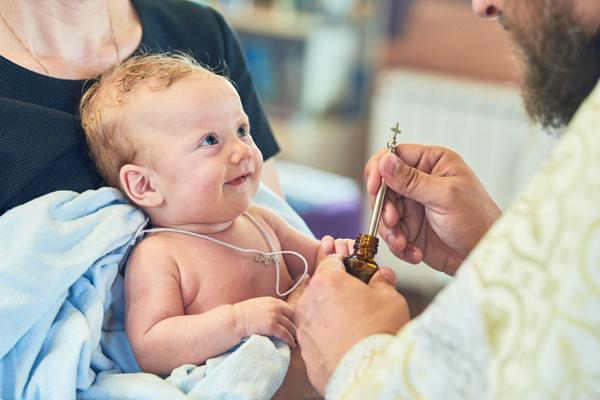
CHALLENGE: If what is ultimately important is our faith in God, there is no reason for the Church to have sacraments.
DEFENSE: Interior dispositions like faith are not the only thing that is important. We are also physical beings. The Church has sacraments because they correspond to human nature and thus Christ instituted them.
Every religion has certain rites it regards as sacred. Such rites are a human universal, found in every religion, in every culture, which means they are rooted in human nature. Thus God made use of them in Judaism and Christianity.
In Judaism there were what are sometimes called the “sacraments of the Old Law.” These included rites such as eating the Passover Lamb, the sacrifices offered at the temple, circumcision, and various washings for purification (see Exod. 12; Lev. 1-7, 12:3, 14:8-9).
While there are a rich variety of rites used in the Christian Faith, certain ones have a special place and are referred to as the “sacraments of the New Law” or the “sacraments of the New Covenant” established by Christ.
Used this way, the word “sacraments” refers to “efficacious signs of grace, instituted by Christ and entrusted to the Church, by which divine life is dispensed to us” (CCC 1131).
In contrast to the rites that were part of the Old Covenant, the sacraments of the New Covenant impart the graces they signify. Each is a visible sign of the invisible grace it imparts. This twofold nature of the sacraments corresponds to the twofold nature of man. We are not simply created spirits, like the angels. By nature, human beings are composed of both body and spirit. Consequently, God imparts spiritual graces to us through visible, bodily signs (see St. Thomas Aquinas, ST III:61:1).
In his ministry, Jesus frequently performed miracles through sensible signs like the spoken word (Mark 4:39; John 11:43-44) and the laying on of hands (Mark 8:23-25; Luke 4:40). This same principle is at work in the sacraments that Jesus established for his Church.
Over the course of time, the Church discerned that there are seven such sacraments: baptism (Matt. 28:19), confirmation (Acts 8:14-17; Heb. 6:2), the Eucharist (1 Cor. 10:16), confession (John 20:21-23), the anointing of the sick (Mark 6:13; James 5:14-15), holy orders (Acts 13:2-3; 2 Tim. 1:6), and matrimony (CCC 1612-17).
Did you enjoy this excerpt? Order your copy of A Daily Defense today!
Recent Posts
-
Choirs of Angels in Scripture
The phrase choirs of angels does not mean a number of angels singing, as they did to announce to th …Mar 24th 2026 -
Explaining Apparitions and Visions of Angels
Church teaching, including Scripture and Tradition, holds that angels are purely spiritual beings. …Mar 15th 2026 -
Where Demons Dwell
And the great dragon was thrown down, that ancient serpent, who is called the Devil and Satan, the …Mar 5th 2026