









Mother of God | Luke 1:43
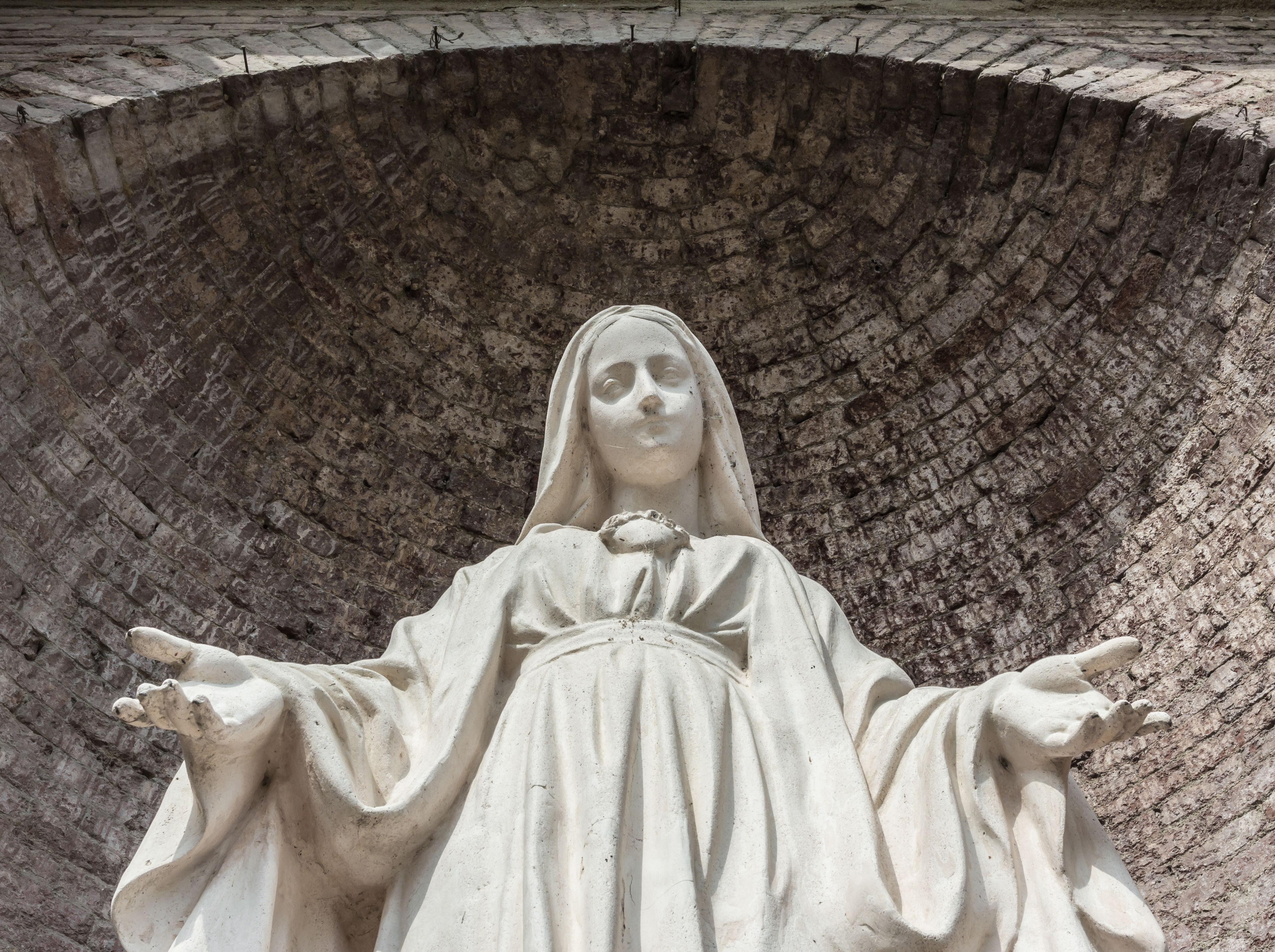
Why Catholics Call Mary the Mother of God?
This excerpt from Meeting the Protestant Response explains why Luke 1:43 supports Mary’s title “Mother of God.” Broussard answers the objection that Elizabeth’s phrase “mother of my Lord” refers only to Jesus as Messiah, showing instead how Luke presents Mary as the new Ark of the Covenant. The excerpt also explains why biblical typology does not require every detail of the Old Testament ark to apply to Mary.
Mother of God
The belief that Mary is the mother of God is not unique to Catholicism. The vast majority of Christians accept this dogma, with only a minority of people in the Protestant community objecting. One text that is appealed to in support of this belief is Luke 1:43. There, Elizabeth, inspired by the Holy Spirit, exclaims to Mary, who just arrived in her presence, “Why is this granted me, that the mother of my Lord should come to me?” Since Elizabeth was a good Jew, and Jews normally used the word Lord in the place of the tetragrammaton (God’s name), YHWH, Elizabeth is calling Mary the mother of God. Therefore, we have a possible biblical foundation for the dogma of Mary, mother of God.
The Catechism of the Catholic Church appeals to Luke 1:43 as biblical support for the dogma of Mary, mother of God. See 448, 495, and 2677.
There are many comebacks that Protestants have to the belief in Mary as the mother of God. But there’s really only one counter-argument made to using Luke 1:43 for scriptural justification of Mary as the mother of God. It targets the assumption that “lord” is intended by Elizabeth to refer to Almighty God.
There is a counter-argument that some Protestants make to the use of this text for Mary’s sinlessness. But we can consider it here for our purposes of defending the appeal for Mary as mother of God, as will become evident below.
“Elizabeth simply uses the title ‘lord’ in the sense of an earthly ruler. She’s referring to the fruit of Mary’s womb, Jesus, as her messianic king, not the divine messianic king.”
Protestant Bible scholar Walter L. Leifeld argues that we shouldn’t interpret this as a reference to Mary, “mother of God.” His alternative interpretation is that Elizabeth was referring to Jesus as the Messiah. He writes:
Nowhere in the [New Testament] is Mary called “mother of God.” Deity is not confined to the person of Jesus (we may say, “Jesus is God,” but not all of “God is Jesus”). She was, however, the mother of Jesus the Messiah and Lord.
The evidence he gives is the fact that Luke frequently uses “Lord” as a title, 95 out of 166 occurrences in the synoptics. And not every one is charged with a divine meaning. Moreover, so Leifeld argues, Jesus is called “Lord” elsewhere in the Lukan birth narrative in a non-divine way (“For to you is born this day in the city of David a savior, who is Christ the Lord”—Luke 2:11).
Answering the Comeback
With regard to the use of “Lord” in reference to Jesus in Luke 2:11, it’s not clear whether it’s being used in a divine or non-divine way. There is nothing in the text that suggests either interpretation. Leifeld simply asserts its divine use without argumentation. Given such ambiguity, we can dismiss this text as evidence for Leifeld’s conclusion.
There’s no doubt, however, that the Greek word translated “Lord,” kurios, is used in a non-divine way in the New Testament (e.g., 1 Cor. 8:5), even by Luke (e.g., 12:36, 37, 42, 43, 45, 46, 47). However, it’s not the word by itself that indicates that Mary is the mother of God. It’s how Luke sees Elizabeth using it.
There are several details that indicate that Luke is drawing a parallel between Mary and the Old Testament Ark of the Covenant. Take Elizabeth’s words themselves, for example. They are almost perfectly mirror David’s in 2 Samuel 6:9, when he says in the presence of the ark: “How can the ark of the Lord come to me?” Other parallels include John the Baptist leaping for joy in the presence of Mary in Luke 1:44 and David “making merry” before the ark in 2 Samuel 6:5. According to Luke 1:39, Mary remains with Elizabeth for three months, similar to how the ark remained in the house of Obededom for the same amount of time according to 2 Samuel 6:11.
Now, since Luke is paralleling Elizabeth’s “mother of my Lord” with David’s “the ark of the Lord,” it stands to reason that Luke intends for us to take Elizabeth’s cry as a reference to almighty God. “Lord” in the phrase “ark of the Lord” wasn’t a reference to the Messiah. The ark was the ark of almighty God. Therefore, we have good reason to interpret Luke 1:43 as a reference to Mary being the mother of God, contrary to Leifeld’s claim.
“If you take some parallels with the ark, then you need to take all of them.”
James White poses a challenge directed at the use of Mary as the new Ark of the Covenant for support for Mary’s sinlessness. But since it’s directed at Mary the new Ark of the Covenant, the counter-argument can be utilized for whatever inferences a Catholic might make from Mary being the new Ark of the Covenant, such as Mary, “Mother of God” in Luke 1:43.
White argues that if we draw parallels between Mary and the Ark of the Covenant, then we’ll be pushed to affirm absurdities. He writes:
Must Mary have been stolen by God’s enemies for a time, so that she could be brought back to the people of God with great rejoicing (2 Sam. 6:14-15)? Who was Mary's Uzzah (2 Sam. 6:3-8)? [Catholic apologist Patrick] Madrid draws a further parallel between the three months the ark was with Obededom and the three months Mary was with Elizabeth. What, then, is the parallel with David's action of sacrificing a bull and a fattened calf when those who were carrying the ark had taken six steps (2 Sam. 6:13)?
White charges that the use of Mary as the new Ark of the Covenant is violating rules of scriptural interpretation, since he perceives it as picking and choosing “those aspects of Mary’s life [a Catholic] wishes to parallel in the ark and those which he does not.”
Answering the Comeback
Our response to this comeback is basically the same that we gave in a previous chapter concerning the interpretative context of the “key of the house of David” (Isa. 22:22) for the giving of the “keys of the kingdom” to Peter (Matt. 16:19). The premise—that some parallels require all parallels—is simply false. That’s not how prophetic foreshadowing or intertextuality works.
As we pointed out before, the New Testament authors themselves don’t honor the principle contained in this hidden premise. Consider the first two verses of Hosea 11:
When Israel was a child, I loved him, and out of Egypt I called my son. The more I called them, the more they went from me; they kept sacrificing to the Baals, and burning incense to idols (1-2).
Matthew takes the phrase “out of Egypt I called my son” in the first statement as a prefigurement of the baby Jesus’ return from the flight to Egypt (Matt. 2:15). Yet Matthew did not intend the latter part of the passage to refer to Jesus: Jesus did not go away from God, sacrifice to the Baals, and burn incense to their images.
There are numerous examples of this in the New Testament’s use of the Old. Whenever prophetic foreshadowing is in play, some elements foreshadow, and some don’t. There are continuities and discontinuities. If the New Testament authors employ this type of hermeneutic when relating the Old Testament to the New, it’s legitimate for Catholics to do the same.
Did you enjoy this excerpt from Dr. Karlo Broussard's Meeting the Protestant Response? Order your copy today!
Recent Posts
-
Worship and Apocalyptic Warfare
Having finished a full draft of this work, I began seeing other themes surfacing in the Book of Rev …Oct 20th 2026 -
What Is a Mortal Sin?
As St. John says, “All wrongdoing is sin, but there is sin which is not mortal” just as “there is s …Oct 15th 2026 -
Mother Teresa: All for Jesus
As we should expect, Mother Teresa’s idea of holiness was simple and direct. For her, sanctity begi …Sep 30th 2026